

“Flying boats, as nice as they are, and they are nice things, are a tremendous responsibility at all hours of the day and the night, whereas with a land plane you step off it and put it in a hanger – and that’s that!”1
Len Grey, Chief Pilot for Qantas Flying Boat Operations.
Owing to extreme weather and lagoon conditions, every flying boat operator at Lord Howe experienced the trauma of aircraft being driven ashore. Overnighting an aircraft at Lord Howe was a particularly risky business. The extreme exposure of the lagoon to wind and sea led to some six aircraft being blown ashore, the first one being an RAAF Catalina during World War II. Fortunately, five of these aircraft ended up stranded on the sandy lagoon beach which facilitated (but didn’t guarantee) their successful salvage. Only a Qantas Catalina – in June, 1949 – was washed onto the rocks near the jetty.
Of these aircraft, two were refloated without any damage (one RAAF and one Trans Oceanic Airways); two were successfully repaired on the beach and then refloated (both Ansett); and two aircraft had to be completely written off (one Qantas and one Ansett). However, the circumstances were similar with each.
Harry Woolnough, Marine Officer responsible for safe lagoon operation at Lord Howe, provides a good description of the conditions in which flying boats were vulnerable to this sad fate.2 “Out of all the [27] years that the flying boats ran here, there were no operational accidents whatsoever, which was a very good record, but breaking away from the mooring is very common with flying boats – as it is with launches and yachts in heavy weather. It occurred wherever flying boats were moored in England and other places…it was always on the cards they could break away from their moorings”.
“[At Lord Howe] This always happened in very heavy weather when they used to stay overnight for various reasons, or sometimes they’d put on a weekend cruise, say Friday to Monday, and that meant they remained on the mooring for those days and nights. Sometimes the weather was OK when they landed but, especially in the wintertime, you were likely to get a sudden burst of very heavy wind …and a big sea would get up. The seas would come in over the reef and cause a very heavy swell in the Lagoon. That caused the aircraft to surge up and down on the mooring buoy and, when they surged back away from the buoy, there would be a very big strain on the mooring buoy wires…. the storm pennant on the flying boat, in each case it snapped, and this always happened at night…”
Although the storm-driven beaching of aircraft affected all four Lord Howe flying boat operators – the RAAF, Qantas, Trans Oceanic Airways and Ansett – the current series focuses on the Ansett operation from 1953 to 1974. During this time three Ansett Sandringham flying boats were washed ashore3. Two were successfully salvaged but one had to be completely written off. Wherever possible, I have used eye-witness accounts of these traumatic incidents which, though somewhat repetitive, give credence to a statement made by TOA’s Chief Pilot, Phil Mathiesen, “If you think back over the years, the moorings at Lord Howe don’t have a very good record!”4
1 Len Grey – Chief Pilot Qantas Flying Boat Operations (Oral History Interview with Chris Murray, recorded 11/4/1988)
2 Harry Woolnough – DCA Marine Officer at Lord Howe Island (Oral History Interview with Chris Murray, recorded 11/4/1988)
3 If bad weather was forecast at Lord Howe, a crew would often stay on board a moored aircraft to keep the engines running; if its nose could be kept into the wind, the strain on the mooring was relieved. However, bad weather often took the crews completely by surprise.
4 Phil Mathieson – Chief Pilot TOA (Interview with Chris Murray recorded 11/2/1988)
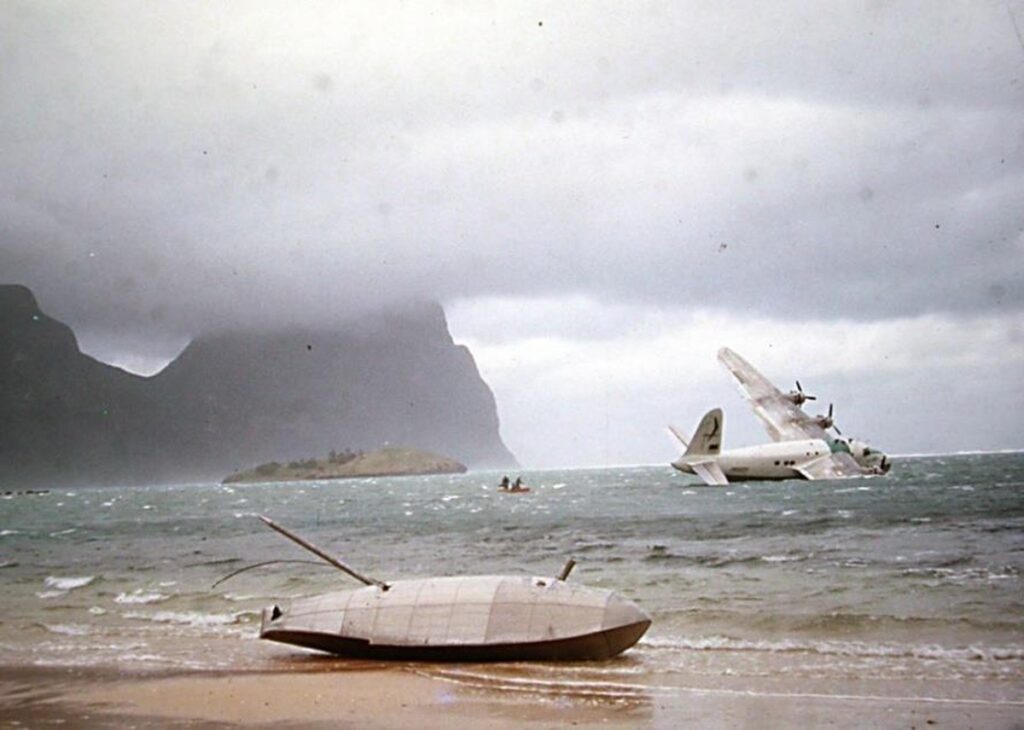
Ansett – Pacific Chieftain on the Beach – 3rd July, 1963
by Stewart Middlemiss, Flying Boat Captain and General Manager of Ansett Flying Boat Services.
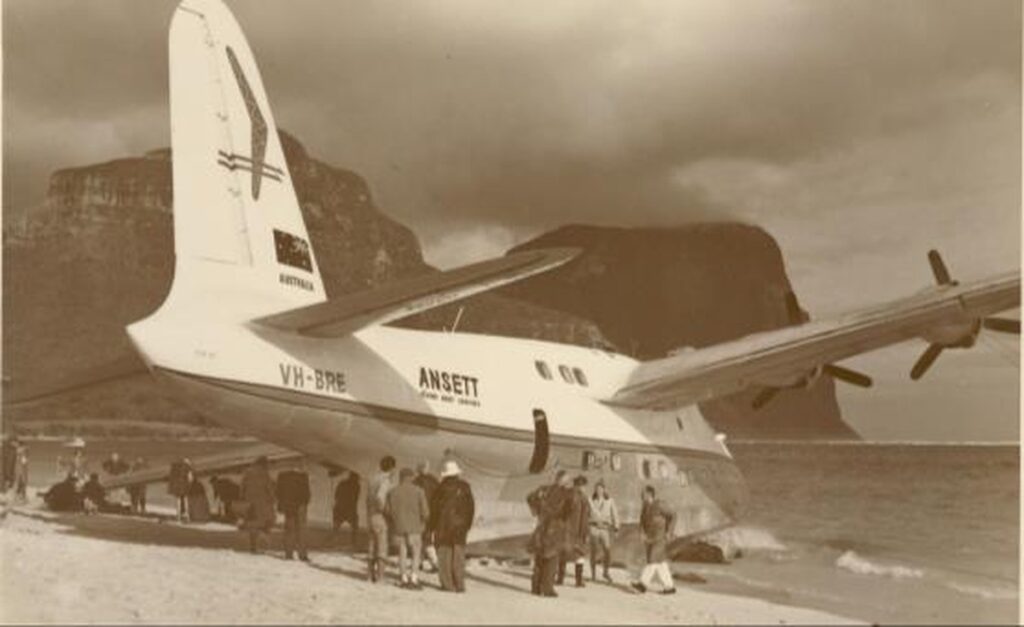
“I was taking a team of bowlers to Fiji in the Sandringham VH-BRE in July, 1963, and, to give a bit of variety, we were going via Lord Howe Island and Noumea. I landed at Lord Howe on 2nd July, disembarked the passengers for the Pine Trees Hotel (sic), and left the aircraft on the mooring. That night a great wind came up and the Sandringham broke away from the mooring. I was awoken at 2 o’clock in the morning with a knocking on my door. “Hey skipper! Your flying boat is up on the beach”.
A heavy sea was pounding in and the flying boat had been washed up on the beach where it was resting on the wingtip, which had bent. It was an awful mess. My first officer was Ron Gillies, who had been a Wing Commander in the RAAF, flying Sunderlands in Britain during the war. He was quite famous and has been mentioned in a few books. I said to him that I thought we ought to leave the aircraft on the beach and sand-bag it until we could do something with it.
“No,” he said. “More waves will come in and damage it further.” So, with the aid of the passengers and hotel staff, we dug a bit of a channel for it. The wing was badly damaged, but the engines were all right and I started them up. It was now fairly calm and conditions were not bad, and we managed to put the Sandringham back on the mooring. The float was off the starboard side so we packed the port wing with sandbags to keep it from swinging around.
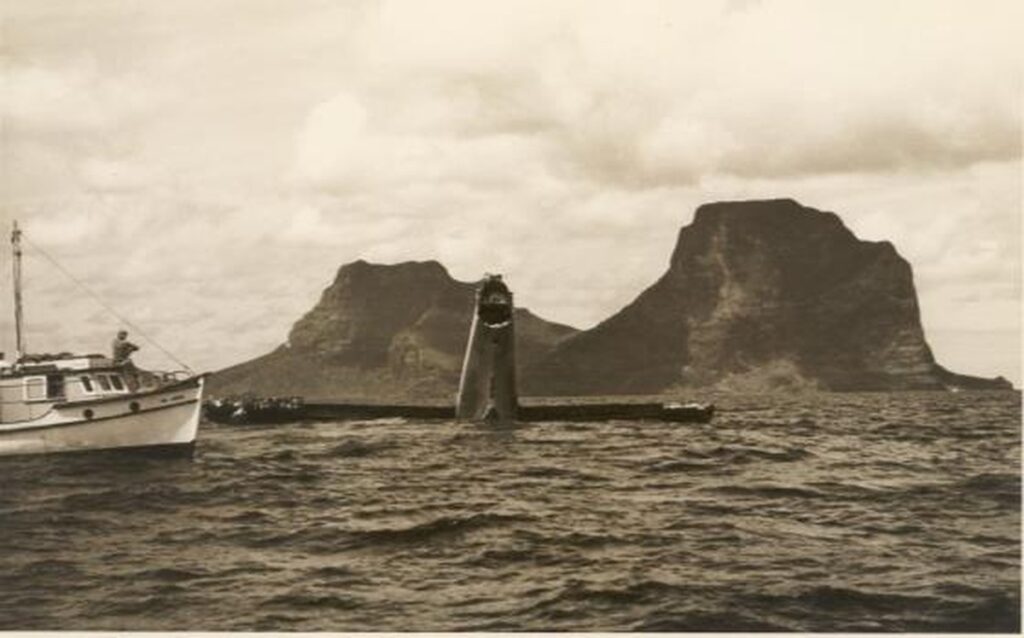
Blow me down if the gale-force wind didn’t come up again that night! The Sandringham collapsed and sank in the lagoon. The salt water and battery acid ruined it. We had to get it out of the way to clear the mooring so, a couple of weeks later, the engineer set to work and raised it enough to drag it through the sand and out of the lagoon. There were only six or seven feet of water in the lagoon at high tide, and this dropped to around three feet at low tide, so it was not hard to pump it out. They towed the Sandringham out into the ocean on a calm morning and sank it in the blue Pacific Ocean. The Islanders sang and threw wreaths and leis on the ocean as the old girl went down. They were rather sad about the whole thing, because the aircraft was almost a part of the Island. We had only one aircraft left and the whole Island depended on that service, so it was a very serious thing for them too”.
Quote taken from: “Greg Banfield, The Stewart Middlemiss Story Parts 1 & 2 in Aviation Heritage Vol.25 No.1, March 1987 & Vol.25 No.2, June 1987”. Photos Courtesy of Paul Shields.
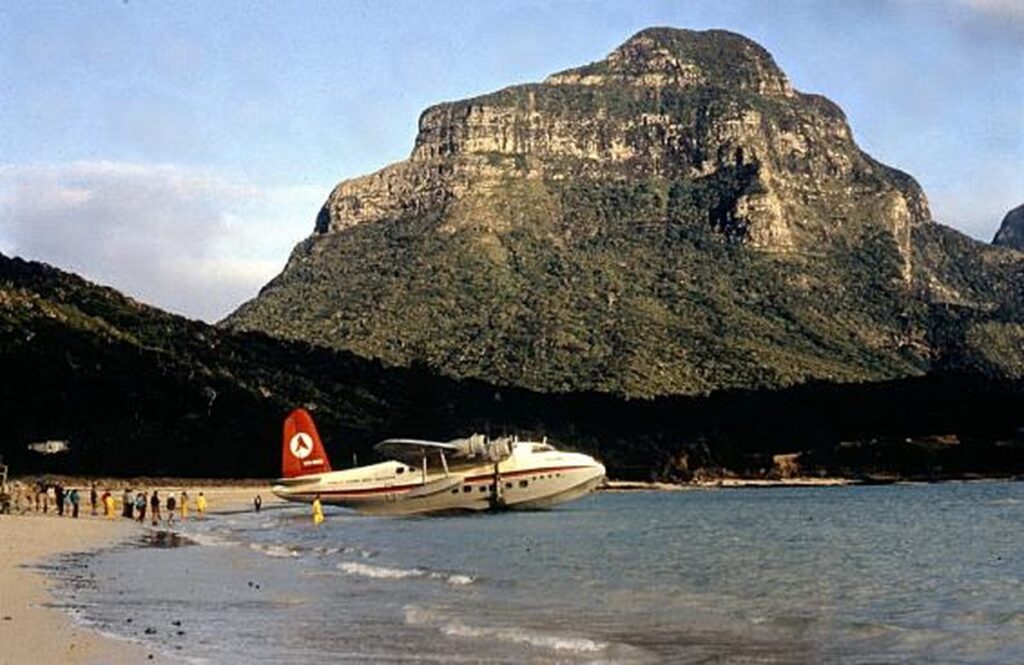
Islander – On the Beach 31st May, 1965
From “The Last Flying Boat” by Peter Smith and oral history tapes held by Chris Murray.
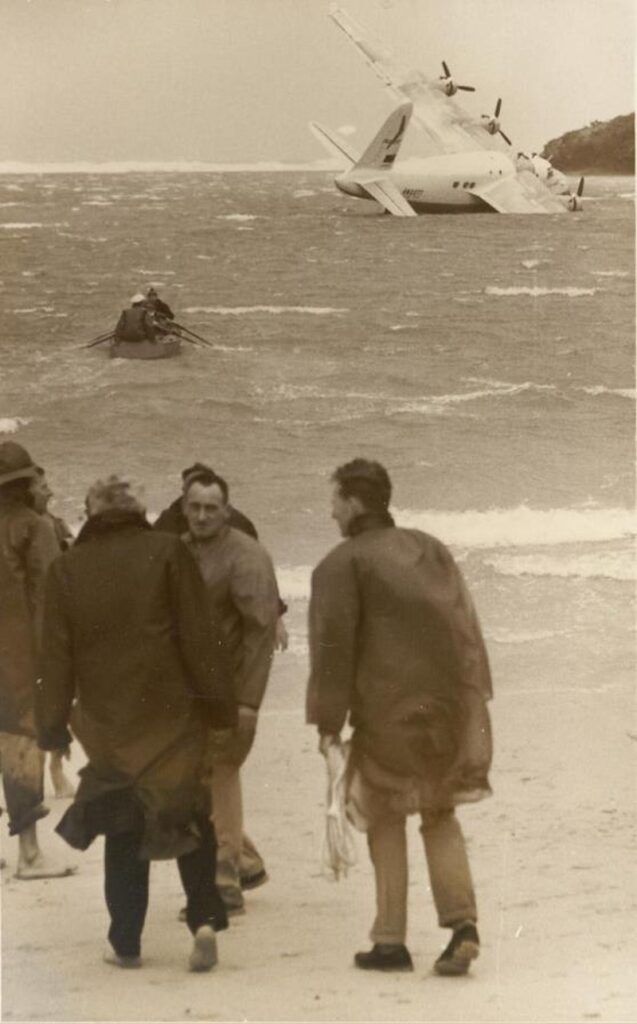
“Islander had been operating on the Lord Howe route for scarcely eight months when near disaster struck, and she almost suffered the same fate as had Pacific Chieftain. She was flown out to the Island on the 31st of May, 1965, on a scheduled service. Having arrived at the Island, a forecast of strong winds caused a decision to overnight with the boat – not too unusual, especially at this time of year…
Mick Nichols was heading up to start duty at the Met Station, around midnight, when he sighted Islander up on the beach at Windy Point – exactly where Pacific Chieftain had come to grief, two years earlier. To raise the alarm he made his way to the Bowling Club – the social centre of the Island – where Jim Dorman was running a dance. Jim recalls the night clearly.
“I stopped the dance, obviously, and called for volunteers. Quite a number, both locals and tourists, volunteered. First, we had to get vehicles and torches to illuminate the beach, as it was a pitch-black night. When we got there, and saw the huge sea running, there were not so many volunteers who would actually wade into the water and do the real work.
“The pilots had been woken and had come down from the Blue Lagoon. One of the floats had broken off and she was laying over on one wing. The pilots’ main concern was to try to raise that wing by sandbagging, to get the strain off it. As she was sitting in soft sand, they did not consider that there would be any real damage to the hull.”
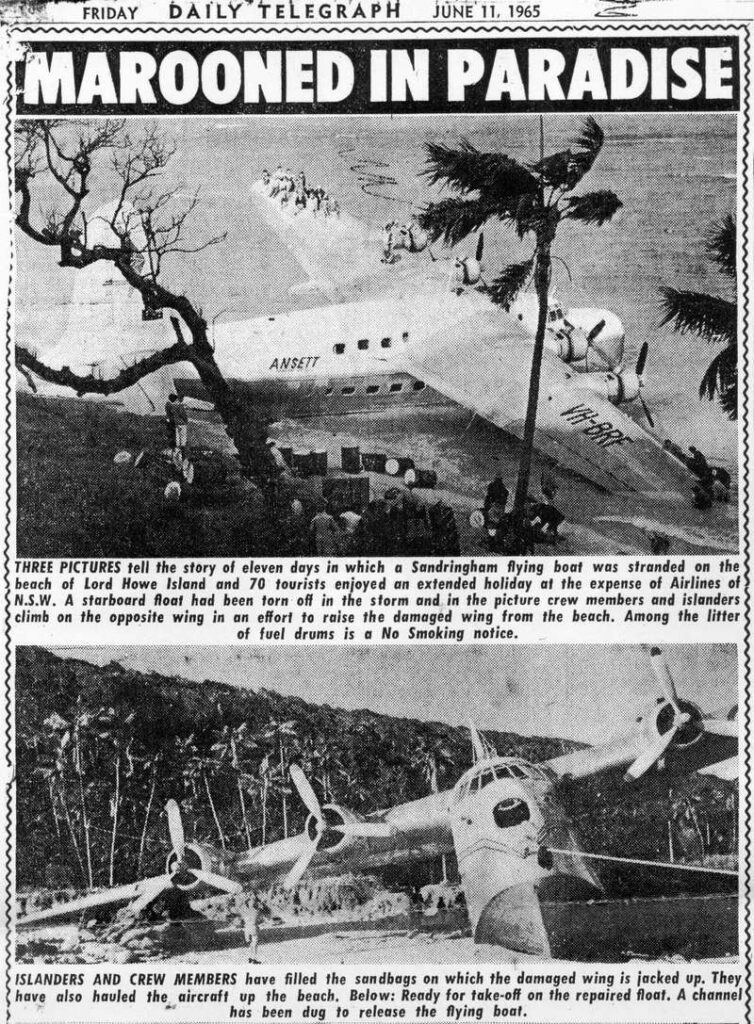
(Editor’s notes: No initial attempt was made to refloat Islander as no one wanted to see the Pacific Chieftain debacle repeated. Instead, work concentrated on getting the aircraft further back up the beach and clear of the pounding waves. The Island’s road grader helped haul the flying boat up the beach. Anchors were then laid out ahead of the aircraft, to try to hold its nose into the sea.
Another important job was to try to lighten the aircraft by unloading its highly flammable Avgas into 44-gallon drums. When one of the Islanders, Frank Payten, lit a cigarette next to the 44-gallon drums containing high-octane fuel, the Ansett flight engineer – Jim Davidson – “roared at him” to put out his potentially incendiary ‘fag’!
In The Last Flying Boat Peter Smith commented, “The only good news about these beachings at Lord Howe Island was that the dangerous winds were the westerlies, and at least these always fetched the flying boats up on the sandy beach, which gave them a chance of survival. Had they been carried onto the reef, there would have been no hope of salvage”.
Jim Dorman continued: “We got a lot of people sitting on the opposite wing to try to get the thing counterbalanced, but all this was happening at night in very, very strong winds and a heavy sea. As you can imagine, it wasn’t altogether what you would call a pleasant job. Those of us below the waterline had the odd big wave breaking over the top of us….”
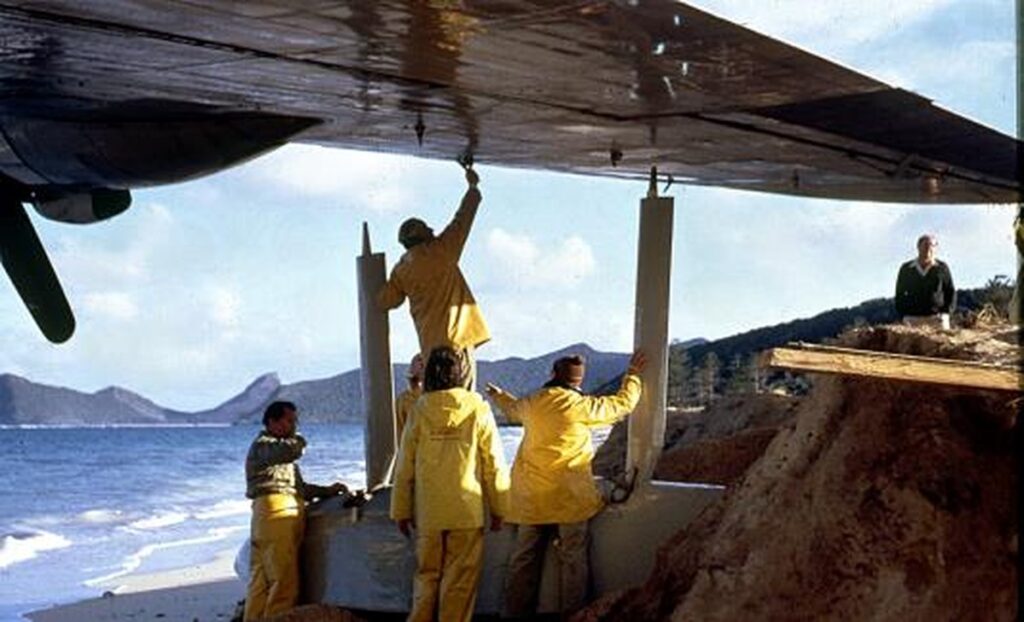
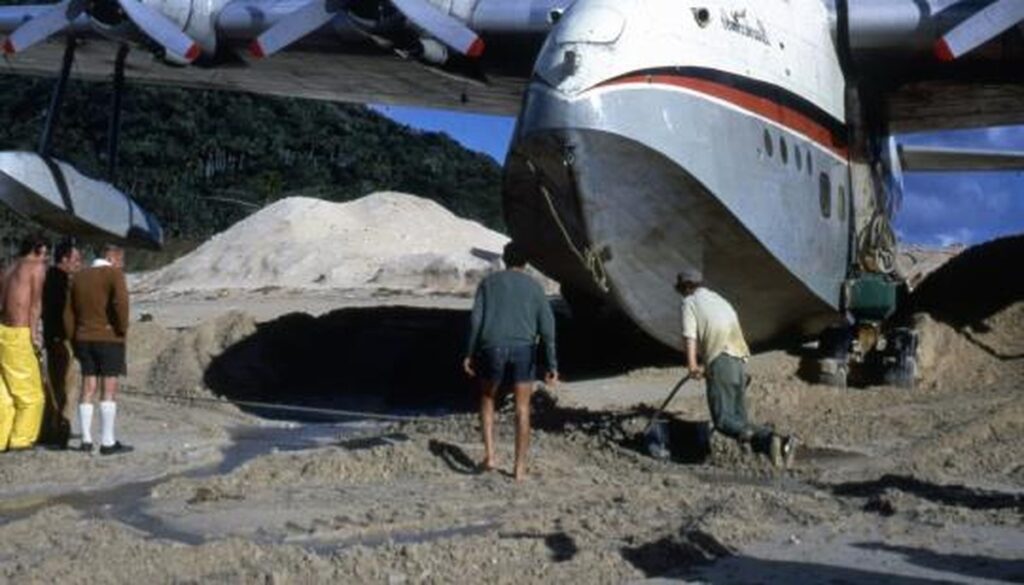
Norm Simpson (a Department of Civil Aviation Employee at Lord Howe) picks up the story: “The Tulagi was loading for Norfolk Island in Sydney and they put the float, and two or three engineers and all the gear they wanted, onto the Tulagi. It was unloaded at Ned’s Beach because of the big seas on the reef. They got the float back on and, once it was repaired enough, we then proceeded to dig a channel around the plane. (Actually, dug down into the beach to make a water channel…and waited for the high tide.) The Alena and Pacific Chieftain [two Island fishing boats] were fastened onto the bow and men with poles and padding were holding the wings up. I think there were about two lots of props either side under the wing just to hold it steady. With very little fuel in it, Captain Bill Wilcher used the four engines. I think he put the throttle ‘through the gate’. He just touched the ailerons a bit to rock it…just a little touch and he had sand and water, you know, going up over the bank….it was just enough to break the suction.”
Then, from The Last Flying Boat: “The five thousand horsepower threw up a vicious spray of sand and water behind the flying boat. They rocked her a little to break the suction, and Islander moved forward. She was back in her element, the sea. After a short test flight she returned to Sydney on the morning of Thursday 10th, crew only on board.
At this stage, consideration was being given to the chartering of an RNZAF jSunderland, as being the only feasible method of getting the stranded passengers off the Island. But the maintenance staff worked feverishly at Rose Bay, mainly to fabricate new brackets for attaching to the wing leading edge, as well as a thorough inspection of possibly stressed components. By Friday 11th, Islander was airworthy again and returned to the Island to bring back the first load of stranded passengers.
The following day, she flew out again to retrieve the last of the ‘castaways’, and the crisis was over. Plans to charter an RNZAF Sunderland did not have to be put into effect. But the total cost of the incident to Airlines of NSW was considerable, and it certainly illustrated the type of problems they could be faced with, through having to maintain the flying boat service”.
Peter Smith – The Last Flying Boat Pp 106-110 (Oral history quotes from Jim Dorman and Norm Simpson were supplied to Peter Smith on cassette tapes by Chris Murray and the LHI Museum.) Photos courtesy of the L.H.I. Historical Society.
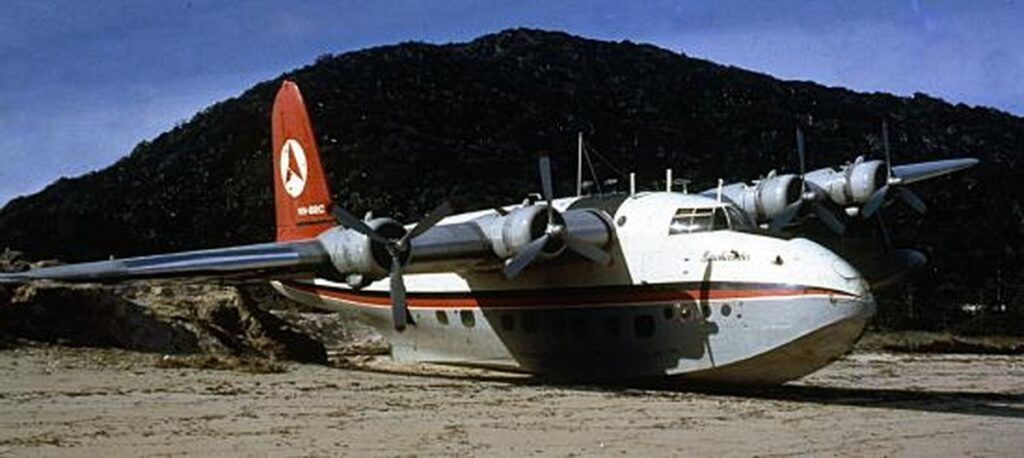
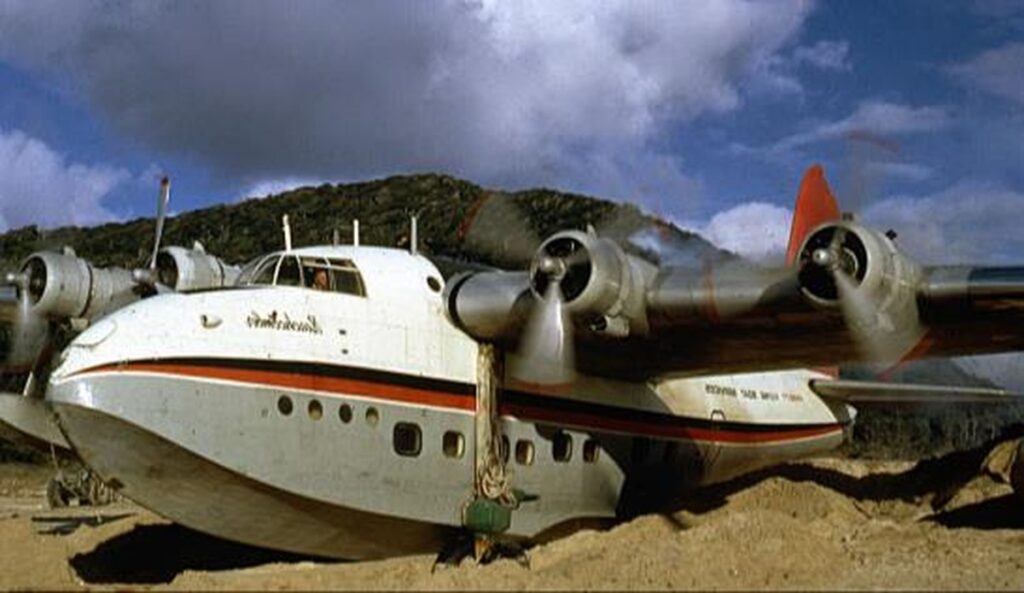
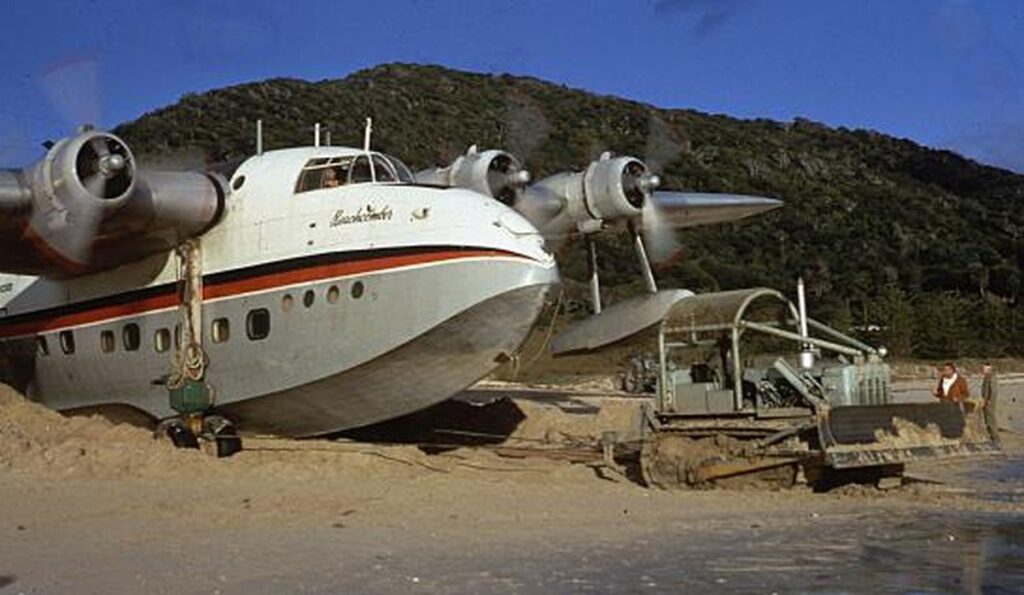
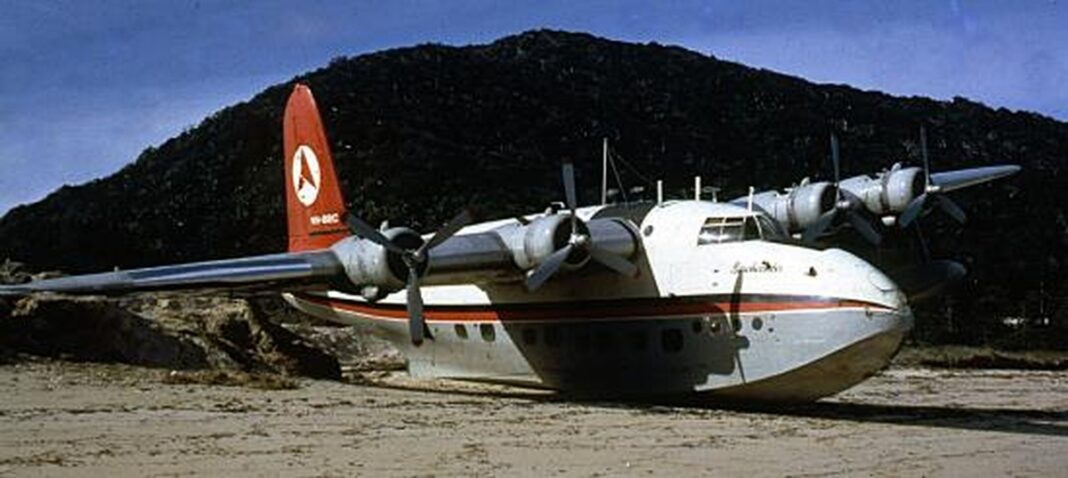
Beachcomber – 10th June, 1974
As Reported by Jim Whistler in the Signal (13/6/74 Volume 2 No. 28) Photos Courtesy of the Chartres Family and the LHI Historical Society.
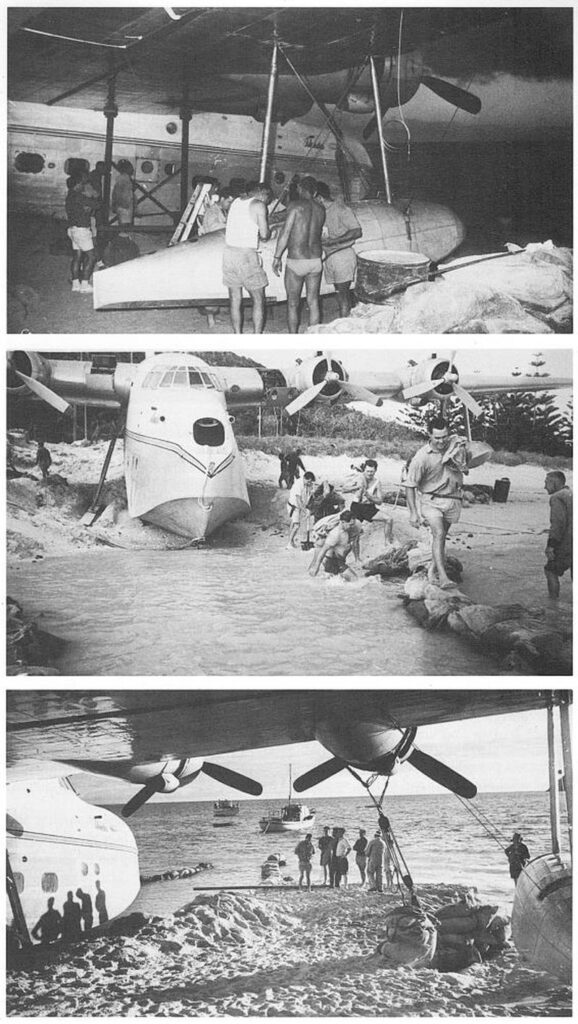
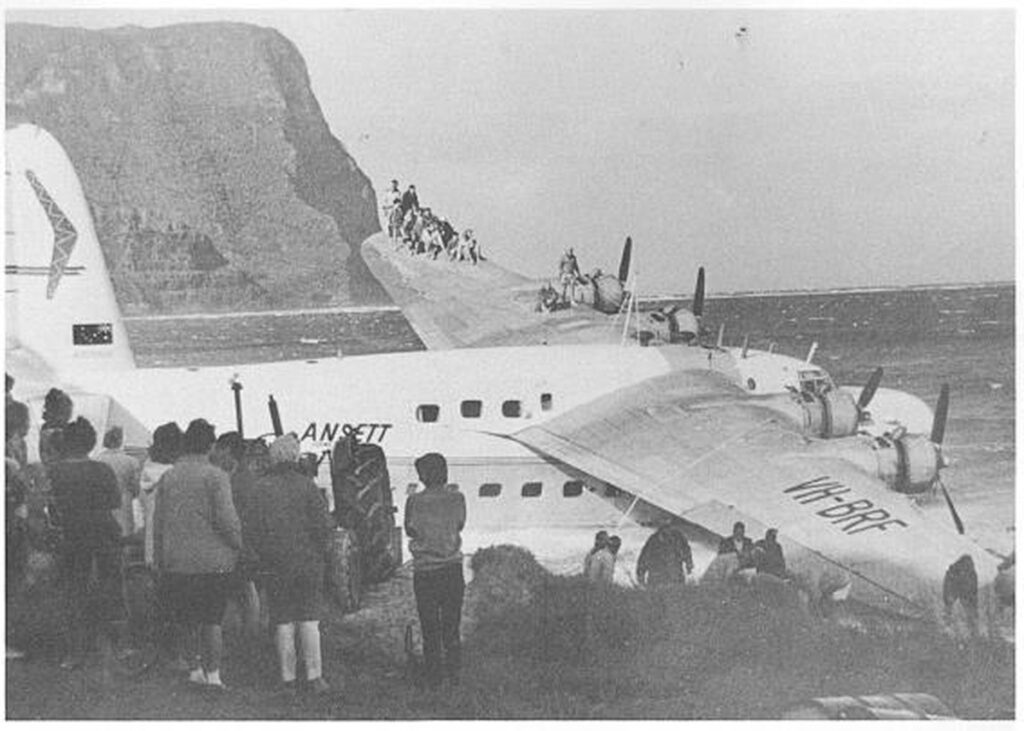
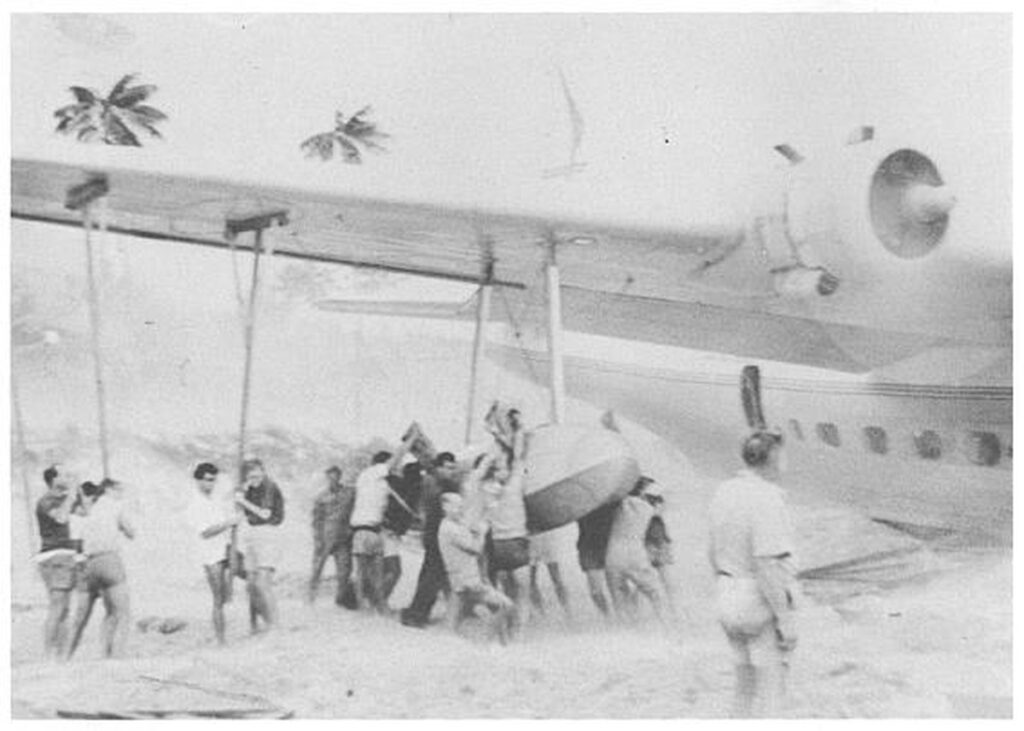
“The flying boat VH-BRC Beachcomber broke free from the south mooring in the early hours of last Monday [13/6] and was discovered on Lagoon Beach in front of ‘Mosely Park’ at about 4.00am by Mr Barry Thompson. The plane has been pulled to the high-water mark and a decision will be made early next week as to whether the plane will be repaired.
Beachcomber arrived on the Island on Friday, 7th June, having been chartered by the Australian Department of Environment and Conservation…and was scheduled to depart the Island at 9.00am on Sunday morning.
A strong Westerly wind during Saturday night resulted in there being a big swell in the Lagoon by 9.00am Sunday. Captain Lloyd Maundrell and First Officer Neil Hayman and crew boarded the Beachcomber at the south mooring [near Blackburn Island] after some difficulty. Due to the conditions on the Lagoon at the time and to the fact that it would be high tide at noon, it was decided to postpone take-off until 3.00pm. However, when Captain Maundrell returned to the terminal he was handed a forecast which indicated that gale force winds would be encountered on the flight to Sydney and that winds on the harbour would probably be in excess of 40knts [74km/hr]. Those who follow closely the operation of the flying boats realised that Captain Maundrell had no alternative but to postpone further the departure time. This he did… and an 8.00am departure was planned for Sunday.
During the late hours of Saturday, the wind swung back in the north-west and freshened continually until by midnight it was gale force. The D.C.A. wind recording instruments on the western side of the Island are not at present automatically recording wind velocity so no official records are available (winds at the radar [Met] station reached 50knots) [92km/hr] but many long-term residents estimate that from midnight until daylight were in excess of 75knots. [139km/hr]
One resident who was disturbed by the gale was Mr Barry Thompson, who decided to drive down from his home to the waterfront. He found “Beachcomber” on the beach being buffeted by big seas and sounded the alarm. A survey by those who were quickly on the scene revealed that little could be done until daylight.
From daylight Monday till after midnight on Monday, residents and members of the Army worked non-stop to move Beachcomber up the beach away from the sea and further damage (to the layman the damage was largely confined to the starboard wing…and the fore cabins had been filled with seawater when the sea buffeted open the front side door…to the expert there is the possibility that the main wing had been strained). The Army made available and used much of their heavy earth moving equipment. By midnight Beachcomber had been moved a short distance up the beach out of immediate danger…and many wet and weary men were able to go to bed after a long day spent in strong wind and numerous squalls.
The day’s operation was supervised by Mr Ron Bush, (Chief Engineer of the flying boat division of Airlines of New South Wales), the Island Superintendent, Mr Horton Ward, and Captain Tony Coyle of the Army. It was highlighted by the willing cooperation of many residents and the Army.
Flying boat, Islander, which was expected to leave next week for the U.S.A., will arrive from Sydney today with an Insurance Assessor and engineers aboard. They will inspect the stranded flying boat and return today to Sydney where a conference next week will decide the future of Beachcomber”.
Editor’s Note: Beachcomber was successfully salvaged with much help from the Australian Army Engineers, who were constructing the Island’s airstrip at the time. The Army Engineers used a dozer to help pull the aircraft up the beach and a tractor/forklift to raise the damaged wing so a new float could be fitted. The salvage effort was facilitated by bringing the aircraft beaching wheels and gear from Sydney, where they were regularly used to get the aircraft from the water into the hangar. These were fitted under the wing. With the help of the four aircraft engines, and a small army dozer, Beachcomber was coaxed back into the water where it was flown back to Sydney for further repairs. This repair work was vital as the aircraft had been sold to Antilles Airboats in the Caribbean. Beachcomber has ended her days at the Solent Sky Aviation Museum at Southampton, England (formerly the Southampton Hall of Aviation), where it remains a feature exhibit to this day.