
– Introduction by Chris Murray
Late last year I was delighted to meet a former Lord Howe “staffy”, Helene Jermolajew, when she dropped in at the Island Museum. We had both worked at Pinetrees guest house in the early 1970s and so found much to reminisce about. Almost a year later (also at the Museum desk), I serendipitously met Fabiola Martin, who was visiting the Island to enjoy a break – but also to write some poetry (in her own words, “a mother, physician and emerging poet of Iranian descent based in Meanjin and Ngunnawal Country, Australia”). Serendipitously, Helene had also found the time to write poems during her 1970s working holiday at Lord Howe. How amazing…the Island continues to inspire poets! So, I asked both Helene and Fabiola to submit a poem (with a short introduction) for publication in the Signal.
“In 1971 I was 20 years old waitressing at Pinetrees. A young woman full of the usual youthful angst and deep feelings. I had been writing poetry since childhood so, of course Lord Howe with its peace, charm and beauty set about inspiring me some more. Although I am a natural rhyming poet I was influenced by fellow waitressing poets to have a shot at prose poetry, after all it was the fashion in the 1970s. Back then communication with the mainland for the staff was only by letter. The flying boats brought holidaymakers, mail and some supplies. The arrival was always filled with joy and laughter, the farewells were always tinged with sadness. The Island has its own way of seeping into your blood and resting there for decades to come.”
Lord Howe Island (Helena)
In the clear blue waters
Of a coral channel
Lives a myriad of life
Colourful,
An underwater rainbow
Always moving,
Always symbolizing
The slow, clear existence
On a Pacific Isle
Watched from a hill above
By undulating,
Breathing fronds
Intermingled with
Vine,
Kentia,
Hibiscus,
Waving a gentle ‘adieu’
To ones hoping to return.
Helene Jermolajew
Sunday 25th September 1971
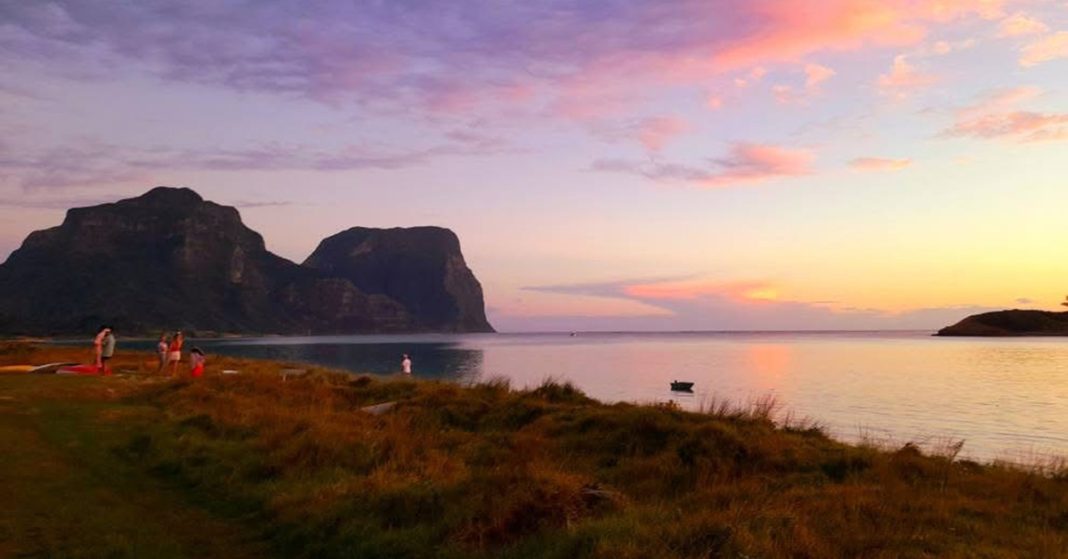
“The Gift came to me while reading Rachel Carson’s The Edge of the Sea. Her writing sent me to Lord Howe Island. Carson never travelled to this paradise on her own but with me she did, and together under the sky-dome of thousands of birdcalls we finalised the poem. The people of Lord Howe Island turned quiet springs to loud, vivacious and exhilarating symphonies. Thank you for showing us how.”
The Gift (Fabiola)
There are only few sounds tonight.
The wind is asleep and breakers
on the barrier beach are distant
murmurs. The sea is hushed to a sigh,
a rhythmic exhalation has put it to bed.
Water cradles shearwater birds; their calls
spook the night and chase ships away.
Only the sharpest ear can catch the sound
of shuffling feet along the sand– sharp grit,
shells being dragged across one another–
hermit crabs, scattered along the waterline;
or discern the spattering tinkle of tiny,
tiny droplets falling off translucent shrimps,
leaping for their lives, clear out of water.
Sleep breathes into us the desire to fly,
fly as high and far as sooty terns,
masked boobies and albatross.
Our ears hear incessant heart beats
and dark seas deliver brain waves
crashing on thirsty shores. While sounds
are still few, the wind and breakers
far-off murmurs, rhythmic exhalations
have put our sea to bed. We dream
of leaping out into another, brighter
dawn. And just when our breaths
deliver one last sigh, shearwater birds
wake us with shrill calls, filled with
the gift of another untouched day.
Fabiola فابیولا